Alma TED vs PRP for Hair Loss in Miami: How They Differ and Who Each May Fit
Alma TED vs PRP for Hair Loss in Miami: How They Differ and Who Each May Fit
Two of the most common questions we hear from people researching non-surgical hair restoration in Miami sound almost identical, but they lead in different directions. The first is “Which treatment regrows the most hair?” The second is “Which treatment is right for my hair loss?” Only the second question has a useful answer, and it starts with understanding that Alma TED and PRP are not competing versions of the same thing. They are two different approaches, built on two different methods, that happen to be discussed in the same breath because both are non-surgical and both are used with the goal of supporting thinning hair.
This article walks through what each one is, how it is delivered, and what tends to shape the decision between them. It is educational, not a treatment recommendation, and it cannot diagnose the cause of anyone's hair loss or determine whether a person is a candidate. Which option — if either — makes sense for you is something a qualified provider evaluates in person.
What Alma TED Is
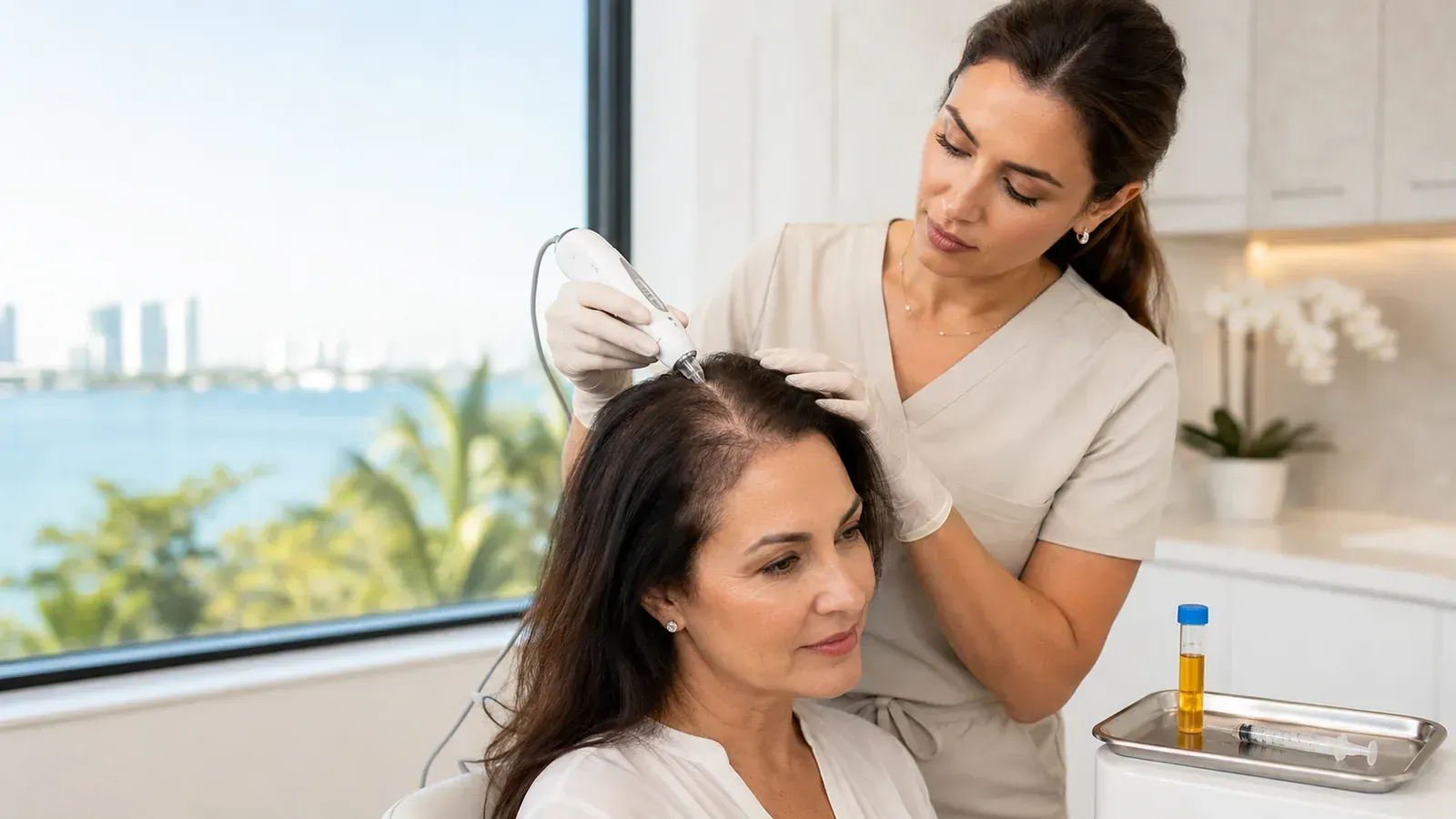
Alma TED is a non-invasive, needle-free device made by Alma. It uses acoustic, ultrasound-based technology together with an air-pressure delivery mechanism to help a topical hair-care formulation reach the scalp without needles, incisions, or injections. The idea behind it is that ultrasound and pressure may help a topical serum penetrate more effectively than surface application alone.
A few honest framing points matter here. Alma TED is not a medication, and it is not surgery. It is one non-surgical, needle-free option that some people consider for hair thinning. Whether it is reasonable for a given person is a consultation question, not something an article can settle.
What PRP Is
PRP stands for platelet-rich plasma. It uses your own blood: a sample is drawn, processed in a centrifuge to concentrate the platelet-rich portion, and that concentrate is then injected into the scalp. Platelets carry growth factors, and the reasoning behind PRP for hair is that delivering a concentrated dose of those growth factors to thinning areas may help support hair follicles.
There is an important regulatory point to be clear about. Using PRP for hair restoration is off-label: PRP is not FDA-approved specifically as a treatment for hair loss. For context, the medications the FDA has approved for androgenetic (pattern) hair loss are topical minoxidil and oral finasteride; PRP, like Alma TED, sits outside that approved-drug category. Off-label use is common and legal in medicine, but it is not the same as approval, and responses vary from person to person.
The Core Difference: How Each One Is Delivered
If you remember one thing, make it this: the two differ most in how they reach the scalp.
- Alma TED works from the outside in. A topical serum is applied, and ultrasound plus air pressure helps drive it toward the follicle. Nothing punctures the skin.
- PRP works from the inside. It requires a blood draw, processing, and injections into the scalp with a needle.
That single distinction drives most of the other practical differences between them, from comfort to preparation to who tends to prefer which.
Needles, Invasiveness, and Comfort
Alma TED is needle-free and non-invasive. Many patients describe the session as comfortable, comparing the sensation to a warm scalp massage. That said, no aesthetic treatment should be described as universally painless, and comfort is monitored throughout.
PRP involves needles at two stages: the blood draw and the scalp injections. Some people tolerate this easily; others find it uncomfortable and prefer a numbing step or a needle-free alternative. For anyone whose main hesitation is needles, that difference is often decisive — and it is a reasonable thing to raise at a consultation.
Downtime and Recovery Considerations
Neither treatment involves surgical recovery, and both are typically done as in-office visits. Aftercare tends to be straightforward and depends on the specific treatment and provider instructions. Because PRP involves injections, some people notice temporary tenderness, minor redness, or mild swelling at injection sites. Because Alma TED does not puncture the skin, aftercare is usually minimal. We would avoid promising “zero downtime” for either; the honest version is that downtime is generally limited and varies by person, and your provider will tell you what to expect.
Sessions and Planning
Neither Alma TED nor PRP is typically a single-visit fix; both are generally planned as more than one session. Beyond that, we are deliberately not publishing a fixed session count or a maintenance schedule, because those vary by person and by treatment and are not something an article can set responsibly. Any improvement may not be lasting, and a provider can explain what ongoing care might involve for a given situation.
What Influences Whether a Non-Surgical Option Is Reasonable
This is where most of the real decision-making happens — and it happens in person. The pattern, duration, and possible cause of hair loss all influence whether a non-surgical option may be reasonable, and those are things a qualified provider evaluates during an assessment. Hair loss has many possible causes, and identifying the likely cause matters before choosing any treatment; the American Academy of Dermatology emphasizes that step.
This article cannot diagnose the cause of your hair loss or determine whether you are a candidate for either treatment — that is exactly what a consultation is for. What it can do is set one expectation plainly: neither Alma TED nor PRP is a hair transplant. Non-surgical treatments and surgical hair restoration address different situations, and where a non-surgical approach is not the right fit, a provider may discuss surgical hair restoration or other options.
Can They Be Combined?
Some people ask whether Alma TED and PRP can be used together. Because they work through different methods, they are sometimes considered at different points within one overall plan rather than as a strict either/or. Whether combining makes sense for a given person — and in what order — is a clinical decision made at consultation, not a default.
Realistic Expectations
Setting expectations honestly is the most important part of any hair-restoration conversation. Responses vary from person to person. Neither Alma TED nor PRP is a cure for baldness, neither permanently stops future hair loss, and neither guarantees regrowth. A provider can give you a far more individualized picture after assessing your hair in person than any article can.
When a Consultation Makes Sense
If you are noticing more shedding, a widening part, a thinning crown, or a receding hairline, the most useful next step is not choosing a treatment — it is getting an evaluation. For background reading, our Alma TED hair restoration guide covers what TED sessions involve in more depth, and our hair transplant vs non-surgical restoration overview is the right companion if you are also weighing surgical options.
Alma TED and PRP: The Main Differences at a Glance
Treatment Method
- Alma TED uses a topical formulation with acoustic or ultrasound-based technology and air-pressure delivery.
- PRP uses a blood draw, processing, and scalp injections.
Needles and Invasiveness
- Alma TED is needle-free and non-invasive.
- PRP requires a blood draw and scalp injections and is minimally invasive.
Comfort and Recovery
- Alma TED is often described as comfortable, but it should not be described as painless.
- PRP comfort varies because injections are involved.
- Recovery is generally limited for both, but it varies by person and by treatment.
Regulatory Position
- No FDA hair-loss claim is made for Alma TED.
- PRP for hair restoration is off-label and is not FDA-approved specifically for hair loss.
Sessions and Treatment Planning
- Both are often planned as more than one session.
- No universal number of sessions should be promised.
- Planning depends on individual evaluation.
What Neither Treatment Is
- Neither is a hair transplant.
- Neither guarantees regrowth.
- Neither is a cure for baldness.
- Neither permanently stops future hair loss.
Frequently Asked Questions
Is Alma TED better than PRP for hair loss?
There is no universal “better.” They use different methods, and the more useful question is which one fits your situation — something determined at a consultation, not from a comparison alone.
What's the main difference between Alma TED and PRP?
Delivery. Alma TED uses ultrasound and air pressure to move a topical serum toward the scalp with no needles. PRP requires drawing your blood, processing it, and injecting the concentrate into the scalp.
Does PRP for hair loss have FDA approval?
No. Using PRP for hair restoration is off-label; it is not FDA-approved specifically for hair loss. For context, the FDA-approved medications for pattern hair loss are topical minoxidil and oral finasteride.
Which one hurts less?
Alma TED is needle-free and is often described as comfortable. PRP involves needles for the blood draw and injections; comfort varies. Neither should be described as universally painless.
Can Alma TED and PRP be combined?
Sometimes they are considered at different points within one plan because they work differently. Whether that is appropriate for you is a clinical decision made at consultation.
How many sessions will I need?
Both are generally planned as more than one session, but the specifics vary by person and treatment, so we do not publish a fixed count here. A provider outlines a realistic plan after an assessment.
Are the results permanent?
No. Neither treatment permanently stops future hair loss or guarantees regrowth, and responses vary from person to person.
Schedule a Consultation
Wondering whether a non-surgical hair-restoration option fits your situation?
That is best answered in person. The pattern, duration, and possible cause of hair loss all shape what is reasonable — and a consultation is where that gets sorted out. Comprehensive Medical Aesthetics serves the Miami and North Miami area. Reserve a consultation to talk through your options.