
Hair Transplant vs. Non-Surgical Restoration: Find Your Best Hair Loss Solution
Hair Transplant vs. Non-Surgical Restoration: Find Your Best Hair Loss Solution
Hair loss decisions get complicated fast because the options don’t solve the same problem.
A hair transplant redistributes hair from a donor area to places where follicles are no longer producing meaningful growth. It’s a structural solution: you’re moving hair to create coverage.
Non-surgical restoration—whether it’s Alma TED, PRP, or medical therapies—works on a different goal: supporting and preserving the hair you still have. That can be powerful if you’re early enough in the process, and disappointing if you’re not.
This guide compares the paths honestly: who each approach fits, what each can realistically deliver, what trade-offs and costs look like, and how to choose a plan that aligns with your hair pattern and your tolerance for downtime, maintenance, and uncertainty.
Who this guide is for (and what it will help you decide)
This is for anyone who’s weighing a transplant against non-surgical options and wants a clear answer to three practical questions:
- Am I a transplant candidate right now—or would that be premature?
- Are non-surgical options worth the time and money for my pattern?
- What’s the most realistic path to an outcome I won’t regret?
Before you choose a treatment: define your hair-loss pattern
Hairline recession vs crown thinning vs diffuse thinning
Your pattern matters more than the name of the procedure.
- Hairline recession often shows up as temple loss, an “M” shape, or thinning along the frontal edge.
- Crown thinning can look mild for years and then accelerate, creating a visible swirl or patch.
- Diffuse thinning spreads across the top and can be harder to camouflage because there isn’t a single “spot” to fix.
Two people can have the same amount of loss and need completely different plans based on pattern.
Why “active follicles” vs “slick bald” changes everything
Non-surgical methods rely on follicles that are still alive, even if they’re weak. If an area has been smooth and bare for a long time, there may be too little activity to work with.
That’s where transplants are often discussed—because they can add coverage where natural regrowth is unlikely.
The most common reasons people don’t get the outcome they expected
Disappointment usually comes from one of these mismatches:
- treating advanced loss with non-surgical methods and expecting new hair where follicles are gone
- getting a transplant without stabilizing ongoing loss, then watching surrounding native hair thin
- choosing an aggressive plan that looks unnatural in real life lighting
- underestimating the timeline and maintenance required for any path
What a hair transplant actually does (in plain terms)
Donor hair basics: what “permanent” really means
A transplant uses hair from a donor region—typically the back or sides—because those follicles are often more resistant to genetic thinning.
“Permanent” in this context means the donor hair tends to behave like donor hair after it’s moved. It does not mean all future hair loss stops.
FUE vs FUT: the practical differences that matter to patients
The main difference is how the donor hair is harvested.
- FUE removes follicular units individually, leaving many tiny dot scars.
- FUT removes a strip of tissue, leaving a linear scar.
Which is better depends on your hairstyle preferences, donor density, scarring tendencies, and the plan your surgeon recommends.
The real timeline: shedding, regrowth, and when results are visible
Transplant timelines require patience.
- early healing happens over days to weeks
- transplanted hairs often shed in the first phase
- visible growth tends to develop gradually over months
A reputable clinic gives you a timeline that sets expectations clearly instead of selling a quick transformation.
The trade-offs: downtime, discomfort, scarring risk, and maintenance
A transplant is a procedure. It involves:
- a healing period
- some level of discomfort
- a risk profile (including scarring and infection risk)
- ongoing maintenance expectations (especially if you’re still thinning elsewhere)
It can be a decisive change, but it’s not a “set it and forget it” solution for many people.
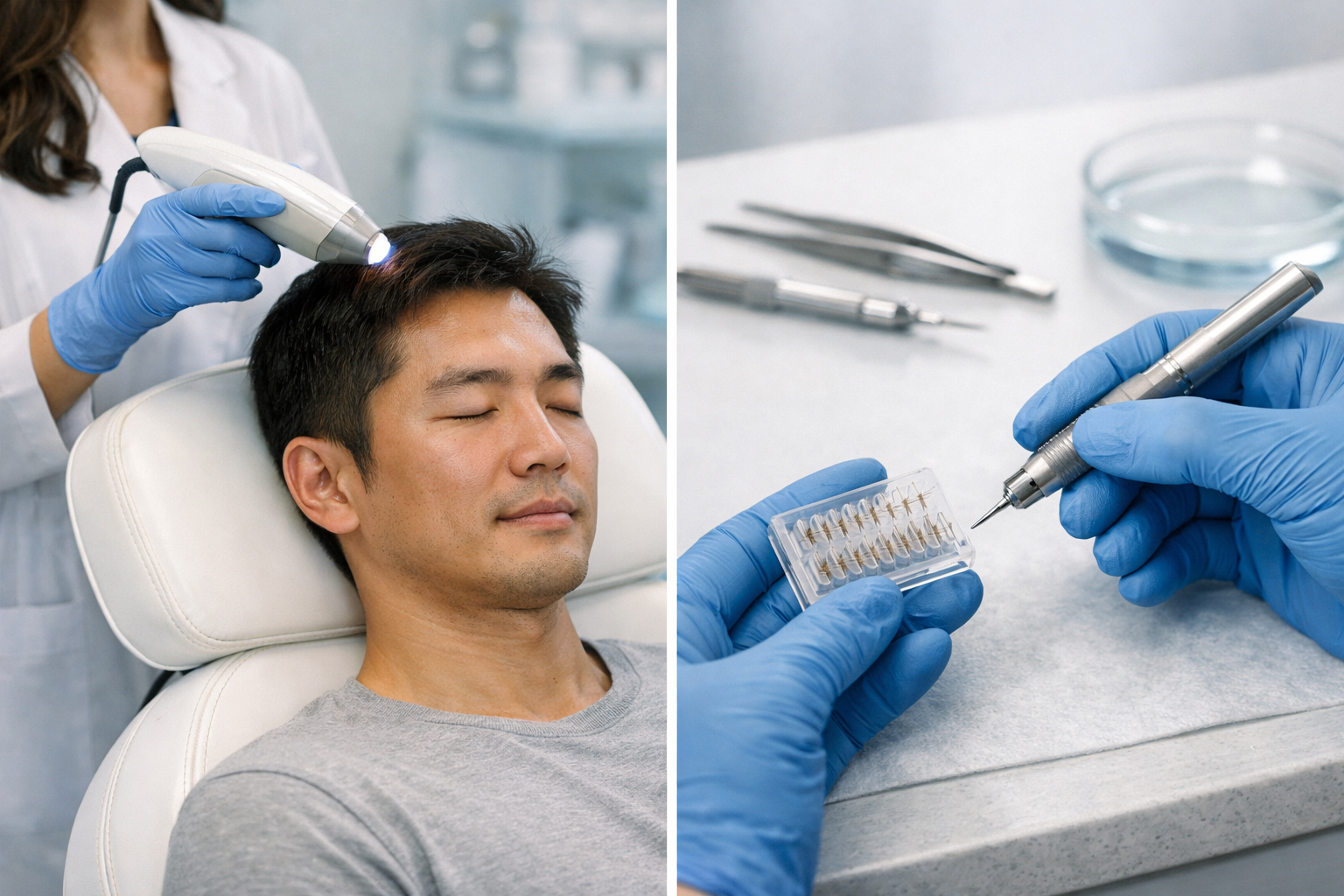
Hairline transplant: when it makes sense (and when it doesn’t)
Best-fit candidates for hairline-focused work
Hairline restoration tends to work best when:
- loss is primarily frontal/temple-based
- donor density is strong
- expectations are realistic about density and styling
- the plan respects natural angles and future loss patterns
Common aesthetic pitfalls: density, angles, and “pluggy” concerns
The biggest aesthetic risk isn’t “having a transplant.” It’s having a poorly planned one.
Natural hairlines are irregular. They have soft transitions. They follow specific angles.
When hairlines are placed too low, too straight, or too dense in the wrong pattern, results can look artificial.
When a conservative hairline plan beats an aggressive one
A conservative hairline often looks better long-term because it:
- respects future thinning
- avoids creating an unnaturally low line
- reduces the risk of a “helmet” effect
If you want the most believable result, conservative design is usually your friend.
Non-surgical restoration: what it can do well (and where it falls short)
Alma TED: where it fits in a plan and who tends to like it most
Alma TED is often positioned as a non-invasive option for people who want scalp and follicle support without needles or downtime.
Where it tends to fit best is early-stage thinning, diffuse shedding, or patients who want a conservative start before committing to more intensive approaches.
PRP: what it’s used for, how it’s done, and what “realistic” looks like
PRP uses your own blood components, processed and applied or injected to support follicle signaling and scalp health.
A realistic frame: PRP may help improve hair quality or shedding patterns in some patients, particularly when follicles are still active. It’s less likely to create dramatic regrowth in areas that have been bald for a long time.
Medical therapies: what they’re designed to protect, and why consistency matters
Medical therapies are often used to slow loss and protect follicles. Their strength is maintenance and stabilization.
The downside is that they require consistency and patience—and they are not the right fit for everyone.
Combining non-surgical options without wasting time or money
Combining can make sense if it’s structured:
- choose one primary path
- track response over time
- add only what addresses a clear gap
A “do everything at once” plan may make it impossible to know what’s helping and can inflate cost without improving outcome.
Alma TED Hair Restoration page.
Side-by-side comparison: transplant vs non-surgical (decision factors people actually care about)
Outcome type: new hair placement vs improving existing hair
This is the core split:
- transplant: adds coverage in areas with limited follicles
- non-surgical: strengthens and supports follicles you already have
“How many sessions?” vs “one procedure + follow-up care”
Non-surgical care often involves a course of sessions and ongoing maintenance.
A transplant is typically one procedure, but still involves follow-up care and long-term planning.
Downtime and visibility: what you can do the same day vs what requires planning
Non-surgical options often allow you to return to normal routine quickly.
A transplant requires planning around healing and visibility—especially if you’re in client-facing work.
Pain/anxiety factors: needles, numbing, and tolerance
Different people have different thresholds. Some prefer a non-invasive approach simply because they don’t want a procedural experience.
Maintenance: what most people still need long-term either way
Many transplant patients still benefit from non-surgical support to maintain surrounding hair and slow ongoing loss.
In other words, the “either/or” choice often becomes a “what first” choice.
hair transplant cost: what drives pricing and what should be included
Graft count and coverage goals (how clinics estimate it)
Pricing is commonly driven by how many grafts are needed to achieve a realistic coverage goal.
That goal should be based on:
- your donor supply
- your pattern of loss
- how you style your hair
- what density is achievable without exhausting the donor region
Why “cheaper” often becomes more expensive later
A cheap plan can become expensive if:
- the design is unnatural and needs correction
- donor supply is mismanaged
- ongoing loss wasn’t considered, creating a “patchy” look later
What a transparent quote should spell out (and what it shouldn’t)
A transparent quote should clarify:
- what’s included in the procedure
- follow-up care and check-ins
- what the clinic considers a successful outcome
- what additional treatments may be recommended
It should not rely on vague promises.
How to choose a realistic path (quick decision guide)
If you’re early-stage thinning and want to avoid surgery
Start with non-surgical options and focus on stabilization. Your future self benefits from keeping follicles alive as long as possible.
If you have clearly advanced loss and want the most decisive change
A transplant may be the more direct option—if you’re a good candidate and donor supply supports your goals.
If your priority is the most natural-looking result
Prioritize conservative design, honest density planning, and a provider who can show consistent outcomes.
If your priority is minimal downtime and flexibility
Non-surgical restoration is often the better first step.
If you’re not sure yet: the “start here” approach that keeps options open
A practical first step is a professional evaluation that clarifies whether you have active follicles in the areas you care about.
If you do, start with non-surgical support. If you don’t, discuss whether a transplant is appropriate.
How to evaluate a provider without getting sold to
Credentials, oversight, and who is actually doing the work
You should know who is performing each part of treatment and what medical oversight exists.
Photos, consistency, and what “proof” should look like
Look for consistent before/after documentation with similar lighting and comparable angles. Be skeptical of single “hero cases.”
Red flags: guarantees, pressure tactics, and vague treatment plans
Walk away from:
- guaranteed outcomes
- rushed consultations
- plans that ignore your pattern and long-term hair-loss trajectory
Choosing a miami med spa for hair-loss care: what to look for
Consultation quality: scalp analysis, history, and a plan you can repeat back
A good consultation should end with you understanding:
- what pattern you have
- what your follicles are likely doing
- what the plan is and why
If you can’t repeat the plan back in one minute, the clinic didn’t do its job.
Treatment transparency: what’s included, what’s optional, and why
You should know exactly what’s included and what’s recommended as optional—and the reasoning behind it.
Follow-through: check-ins, progress tracking, and course-corrections
Hair restoration requires tracking. A clinic should be willing to adjust the plan based on response.
Med spa miami patients choose for long-term maintenance: what “good” looks like
Maintenance schedules and how they’re adjusted over time
Maintenance depends on response. Some patients benefit from periodic support to sustain results.
What to do if you plateau (and when switching approaches is smart)
Plateau doesn’t always mean failure. It may mean your current plan has maximized what your follicles can do. That’s when you discuss:
- whether you need a different modality
- whether your goals require surgical redistribution
- whether your expectations need recalibration
A plan that respects budget without quietly lowering the outcome
A budget-friendly plan isn’t “less treatment.” It’s a plan that prioritizes what matters most and avoids unnecessary stacking.
Questions to bring to your consultation (so you leave with clarity)
“What result is realistic for my pattern—and by when?”
This question forces honesty. A good provider gives you a realistic timeline and defines what success means.
“What happens if I do nothing for 6–12 months?”
This clarifies urgency. Some people benefit from starting early. Others can wait. You should hear a candid answer.
“What would you recommend if this were your hair?”
This often reveals whether the provider prioritizes conservative long-term planning or a quick sale.
FAQ
“Can non-surgical treatments replace a transplant?”
Sometimes, if you still have active follicles and your goal is thickening and stabilization. If areas are significantly bald with minimal follicle activity, non-surgical methods are less likely to create the coverage a transplant can.
“If I get a transplant, will I still keep losing hair?”
You can. Transplanted hair may be more resistant, but native hair can continue to thin. That’s why long-term planning and maintenance are often discussed.
“How long before I can work out, swim, or be in the sun?”
It depends on the approach. Non-surgical treatments often have minimal downtime. Transplants require a structured healing window. Your provider should outline timing clearly.
“What’s the biggest mistake people make when choosing a solution?”
Treating the wrong problem. Trying to regrow hair where follicles are no longer active—or getting a transplant without stabilizing ongoing thinning.
“What if I’m embarrassed to start—can treatment still be discreet?”
Yes. Discretion should be part of the care experience. Many non-surgical options are low-visibility, and consultations should feel private and professional.
Next steps
The best plan is the one that matches your pattern, your goals, and what your follicles are capable of.
If you want clarity, start with an evaluation that answers two questions: How active are the follicles in the areas you care about, and what outcome is realistic for your pattern? From there, you can choose a conservative non-surgical plan, a transplant consultation, or a staged approach that keeps your options open.