
Under-Eye Filler Q&A: Brighten Tired Eyes Safely
Under-Eye Filler Q&A: Brighten Tired Eyes Safely
The under-eye area is one of the first places people notice when they feel run down—sometimes in photos, sometimes under harsh bathroom lighting, sometimes after a stretch of poor sleep or stress. And it’s also one of the easiest places to misunderstand. “Tired eyes” can mean hollowing, true puffiness, pigmentation, skin texture changes, or a combination of all four. That distinction matters because the under-eye is not forgiving when the wrong solution is applied with too much product or the wrong technique.
This Q&A is written with one priority: helping you make a safe, informed decision. You’ll learn what under-eye filler can realistically do, who tends to be a good candidate, what bruising and swelling look like in real life, how to reduce the odds of looking puffy, and when alternatives are the more responsible path.
What most people mean by “tired eyes” (and why the cause matters)
Hollowing vs. true puffiness vs. pigment: three different problems that look similar
Most under-eye concerns fall into a few broad buckets:
- Hollowing (volume loss): The area between the lower eyelid and upper cheek can lose support over time. Light hits the hollow and creates a shadow that reads as fatigue, even when you feel fine.
- True puffiness: Some people have natural under-eye “bags” from prominent fat pads, fluid retention, allergies, or anatomy. Puffiness is a volume
excess, not a deficit.
- Pigment and skin quality: Dark circles can be driven by melanin, visible vessels through thin skin, or surface discoloration. Fine lines and crepey texture can make the area look older or more tired even without obvious hollowing.
These can look similar in selfies and mirror checks, which is why the first step shouldn’t be “What filler do I need?” It should be “What’s actually causing what I’m seeing?”
Why the wrong “fix” is how people end up looking puffy
A common mistake is treating puffiness as if it’s hollowing—adding volume where there’s already too much. Another is using too much product in an area that naturally attracts and holds water. Under-eye filler requires restraint, precise placement, and a willingness to say “not a filler candidate” when that’s the safest call.
What a good assessment includes before anyone talks about injections
A thoughtful consultation typically includes:
- A close look at your anatomy in
different lighting and
different expressions (smiling changes the under-eye).
- Discussion of factors that affect swelling: allergies, sinus issues, fluid retention, sleep, and lifestyle.
- Evaluation of skin thickness and how visible veins or pigment may be contributing.
- A plan that’s tailored—sometimes the best solution is not filler, or not filler
alone.
fillers for under eye bags: what they can improve (and what they can’t)
The realistic goal: softer shadows, not a brand-new face
Under-eye filler can be excellent for shadowing from volume loss, where the goal is to blend the transition between the lower lid and cheek. The best results are subtle: you look rested, not “done.” If someone can immediately tell you had something placed under your eyes, it was likely too much—or not the right approach.
When the under-eye area responds beautifully
You’re more likely to love the outcome when:
- The main issue is a
hollow/indent rather than a true bag.
- You have decent skin quality and not a lot of laxity.
- The plan is conservative and built around small amounts.
Often, under-eye improvement is less about filling the under-eye directly and more about restoring support in the upper cheek so the under-eye looks smoother by association. That kind of nuance is usually what separates refined work from visible filler.
When “bags” are mostly fat or fluid and filler is the wrong tool
When the primary issue is a noticeable protruding fat pad or frequent swelling, adding volume can make the area look heavier. In that scenario, the more honest options are conservative non-filler strategies, skin-focused treatments, or a surgical opinion when appropriate. A responsible provider won’t force filler into an anatomy that’s unlikely to benefit.
Who’s a good candidate—and who should skip it
A quick candidacy checklist (age, anatomy, skin quality, lifestyle)
Good candidates often share a few traits:
- Clear under-eye hollowing that looks like
shadow, not a bulge.
- Skin that can tolerate subtle volume changes without obvious texture issues.
- Realistic expectations and comfort with a gradual approach.
Age matters less than anatomy. Some people in their twenties are great candidates; some people in their forties are not—because their under-eye issue is not volume loss.
Red flags that increase the odds of swelling, bumps, or dissatisfaction
A few factors can make under-eye filler higher risk:
- Significant, persistent under-eye puffiness.
- Very thin skin with prominent vessels.
- Strong tendency toward fluid retention or swelling.
- Prior filler in the area that never “settled” well.
- A desire for a dramatic change in one session.
None of these automatically exclude you, but they do change the risk–benefit conversation. Under-eye filler is a place where “pushing through” is rarely worth it.
Situations where a conservative plan beats a quick fix
If your schedule requires you to be camera-ready quickly, or if you’re prone to bruising and swelling, a conservative plan is often the only plan that protects your outcome. That may mean staging treatment, treating adjacent areas first, or choosing alternatives that match your underlying issue.
Safety-first basics for a high-risk, high-reward area
Why the under-eye area is different from other filler zones
The under-eye is delicate: thin skin, complex vasculature, and little room for error. Small placement differences can change how light reflects. Even a well-placed product can look wrong if too much is used. This is also an area where swelling can linger longer than people expect.
How experienced injectors reduce risk without overpromising
A safety-first injector tends to be consistent about:
- Small, measured product amounts.
- Technique designed to minimize trauma.
- Willingness to stop early rather than “chasing perfection.”
- Clear discussion of what to do if swelling or irregularity occurs.
They also avoid guaranteeing outcomes. Under-eye filler is not a certainty; it’s a calculated choice.
What “reversible” really means and why it matters in this region
Most under-eye fillers used today are hyaluronic acid-based and can typically be dissolved with an enzyme if needed. That matters because it creates an exit strategy. However, “reversible” is not a casual promise—it still requires clinical judgment, and dissolving is a medical decision with its own considerations. The safest approach is not relying on dissolving as a backup plan, but placing filler conservatively enough that dissolving is rarely necessary.
Juvederm dermal fillers: How product choice affects outcome under the eyes
Why product selection matters more here than almost anywhere else
Different fillers behave differently. Some spread softly; some hold shape; some are more prone to drawing water. The under-eye tends to punish product choices that are too thick or too hydrophilic for that specific anatomy. A product that looks beautiful in cheeks or lips might be a poor match under the eyes.
What characteristics tend to work best for the under-eye area (texture, spread, water attraction)
In plain terms, under-eye filler tends to work best when it:
- Integrates smoothly rather than sitting as a distinct lump.
- Provides subtle support without bulk.
- Is chosen with swelling risk in mind.
This is where experience matters more than brand names. A thoughtful provider chooses the product based on your anatomy and your risk profile—not what’s trendy.
When “less is more” is the safest aesthetic strategy
In the under-eye area, restraint is not just an aesthetic preference; it’s a safety strategy. Overfilling can create persistent puffiness, unevenness, or a heavy appearance that’s difficult to ignore in everyday lighting.
What the appointment actually looks like (step-by-step)
Consultation: mapping the problem before discussing treatment
A strong appointment typically starts with analysis, not needles. The provider should identify whether your concern is shadowing, puffiness, pigment, or texture—and explain why they’re recommending (or not recommending) filler.
You should leave the consult understanding the plan in plain language. If the explanation feels vague, that’s not a small issue in a high-stakes area.
Comfort: numbing options and what people typically feel
Most people describe under-eye treatment as more strange than painful—pressure, mild pinching, or a brief sting. Numbing options vary, and comfort should be addressed without rushing you.
Technique overview: what a careful injector is watching for in real time
You don’t need a technical lecture, but you should expect a careful pace. A cautious injector is watching symmetry, skin response, and how the area behaves with small adjustments. They’re also prepared to stop if the tissue response suggests that continuing would compromise the result.
Immediate after: what you’ll see in the mirror the same day
Immediately after, it’s common to see mild swelling, slight unevenness from tissue response, or small areas of redness. That doesn’t mean the result is “wrong.” Under-eye filler settles. The best approach is to judge results after the initial swelling window—not in the first ten minutes.
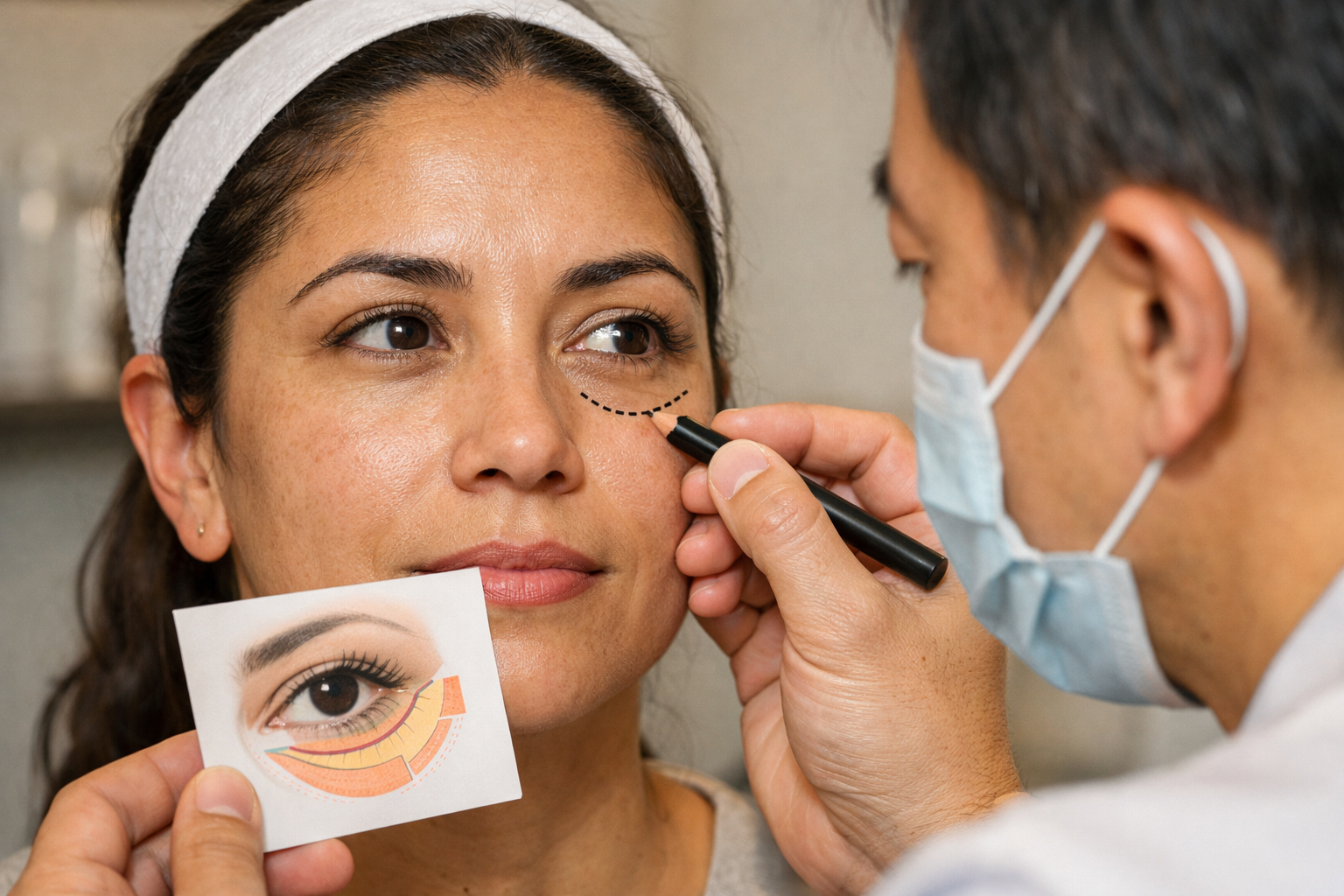
Bruising and swelling: what to expect and how to plan around it
The typical timeline (day 1 through week 2)
While experiences vary, a realistic timeline often looks like this:
- Day 1–2: Swelling is most noticeable; some tenderness or tightness can occur.
- Days 3–7: Bruising, if it happens, is usually most visible here and begins to fade.
- Week 2: The area typically looks more settled; this is often the earliest window to evaluate outcome calmly.
Some people have almost no bruising. Others bruise easily despite perfect technique. That variability is normal and should be discussed openly.
What makes bruising more likely (and what you can control)
Bruising risk increases with personal tendency, blood-thinning medications or supplements, alcohol intake, and recent vigorous exercise. The safest approach is to disclose everything you take—prescriptions, over-the-counter meds, and supplements—so your clinician can advise appropriately.
Makeup, sunglasses, work events: practical planning tips
If you have an event, plan the appointment with buffer time. Most people do best with at least two weeks before anything important. If you’re scheduling close to travel or major work obligations, ask for a conservative plan and be honest about what you can tolerate in terms of downtime.
How long results last—and what “maintenance” usually means
The difference between early settling and true final results
Under-eye filler can look slightly different week to week early on. Swelling decreases, the product integrates, and the skin settles. That’s why most reputable injectors avoid “fixing” small concerns too soon.
When a touch-up makes sense (and when it’s a warning sign)
A touch-up can be reasonable if the initial plan was intentionally conservative and the area has settled. It becomes a warning sign when someone is trying to build volume rapidly because the desired look is unrealistic or the initial candidacy wasn’t ideal.
What can shorten longevity (and what often helps it last)
Longevity varies based on metabolism, product choice, and how much movement and swelling the area experiences. A conservative approach tends to age better than aggressive filling. Even when results last a long time, that doesn’t mean you’ll never need adjustments—your face continues to change.
How to avoid looking puffy (and what to do if you start to)
The two most common causes of under-eye puffiness after filler
Persistent puffiness after under-eye filler most often comes from:
- Too much volume placed in the wrong plane for that anatomy.
- Water attraction and swelling in tissue that’s prone to holding fluid.
Sometimes it’s a mismatch between the product and the patient. Sometimes it’s technique. Often it’s simply too much, too quickly.
The role of conservative dosing and placement
The safest prevention is a conservative plan: small amounts, staged treatment, and clear follow-up. It’s also why provider selection matters so much—because restraint is a clinical decision, not just a stylistic one.
When to wait it out vs. when to correct it
Mild swelling early on is common and often resolves. Persistent puffiness that lasts well beyond the settling window deserves evaluation. A responsible clinic should guide you through next steps, which might include observation, targeted adjustment, or dissolving when appropriate. The correct response is calm and clinical—not dismissive.
fillers under eyes cost: what pricing depends on (and what you should ask)
Pricing can be confusing because under-eye filler is often described in “syringes,” which is not how patients experience results. Many under-eye treatments require less than a syringe. In some cases, the best plan is to treat the upper cheek first, which changes the pricing discussion entirely.
What typically drives cost: product, amount, technique, follow-up care
The biggest drivers tend to be:
- The product used
- The total amount needed (often small)
- The injector’s expertise and time
- The follow-up plan (including touch-ups or assessment visits)
A clinic that does the area safely usually builds time into the process—both for the procedure and for thoughtful follow-up.
What “one syringe” really means in the under-eye area
One syringe does not necessarily mean one syringe under each eye. Under-eye work is often measured in fractions. A skilled injector may use a small amount precisely and stop, even if there is product left, because the anatomy has reached its safe limit.
How to compare quotes without accidentally choosing the riskiest option
Instead of asking only for price, ask what the plan includes:
- Is the approach staged?
- What follow-up is included?
- What happens if swelling persists?
- How will candidacy be determined?
Low prices are not automatically unsafe, but under-eye filler is not an area where bargain shopping tends to end well.
When alternatives make more sense than filler
When pigment is the main issue (and why filler won’t help)
If dark circles are primarily pigment-related, volume won’t address the cause. Filler can reduce shadowing, but it won’t correct surface discoloration. In those cases, skin-focused treatments and medical-grade skincare are often the more honest path.
When skin quality is the limiting factor (texture, laxity)
Crepey under-eye skin, fine lines, and laxity can make filler look less smooth. Sometimes improving skin quality first changes whether filler even makes sense later. Sometimes the best plan is a skin-based approach alone.
facial fat transfer miami: when longer-term volume restoration may be a better fit
For some patients, especially those with broader midface volume loss or who prefer a more structural approach, facial fat transfer miami may be part of the conversation. This is not a quick decision and not a casual alternative—fat transfer is a procedure with different trade-offs, different downtime, and a different risk profile. But in the right candidate, it can offer a more comprehensive volume restoration strategy than under-eye filler alone.
When surgery is the most honest answer (and how a good clinic handles that conversation)
If under-eye bags are largely due to prominent fat pads, surgery may be the most direct solution. A trustworthy clinic handles this conversation with clarity and respect: not pressure, not judgment, and not filler as a substitute for an option you should at least understand.
Dermal fillers near me: choosing the right provider for an under-eye treatment
If you’re searching dermal fillers near me, you’re not just looking for convenience. You’re trying to find someone who can treat a delicate area without overfilling, overpromising, or taking shortcuts.
What to look for in training, approach, and consultation style
Look for an approach that emphasizes:
- Conservative dosing
- Clear explanation of candidacy
- A plan for follow-up
- Comfort discussing alternatives
A good consultation feels like medical decision-making, not a menu.
The “safety questions” that reveal how the injector thinks
Ask questions that force clarity:
- “What makes me a good or poor candidate?”
- “What’s your plan if I swell or don’t like the result?”
- “How do you decide product choice in this area?”
- “Would you ever recommend not doing filler here?”
A provider who answers directly—without defensiveness—usually takes safety seriously.
What a responsible clinic will say about risks, reversibility, and expectations
You should hear a balanced explanation. Under-eye filler can look excellent, but it has limits and it carries real risks. The goal isn’t to scare you; it’s to ensure you’re consenting to the reality, not a filtered version of it.
A pre-appointment checklist for patients who want to minimize bruising and swelling
What to avoid before treatment (and what to clear with your prescribing physician)
Do not stop prescription medications without medical guidance. If you’re on blood thinners or have a medical condition affecting bleeding, your provider should coordinate recommendations appropriately.
For non-prescription items, disclose supplements and over-the-counter medications. Your clinician may advise timing adjustments when safe, but those decisions should be individualized.
What to do the day before and day of
The simplest preparation often helps the most:
- Arrive well-hydrated
- Avoid alcohol if you’re prone to bruising
- Plan a calm day afterward rather than stacking appointments
What to have ready at home for the first 48 hours
Have a low-key recovery setup: gentle cold compress guidance from your clinic, a plan to sleep with your head slightly elevated if swelling is common for you, and minimal social pressure to “look perfect” immediately.
FAQ (safety-first, patient-level answers)
Is it safe to put filler under the eyes?
Under-eye filler can be safe when performed by an experienced medical injector using conservative dosing, appropriate product choice, and careful technique. It’s also an area with higher stakes than many other parts of the face. Safety depends heavily on candidacy and provider judgment. If a clinic treats every under-eye concern the same way, that’s a reason to pause.
Does it hurt?
Most patients describe it as mild discomfort—pressure, brief stinging, or a strange sensation rather than severe pain. Numbing options and technique can make a meaningful difference. If you’re anxious, discuss comfort strategies during the consult.
How long will swelling last?
Some swelling is common early on. Many people look noticeably more settled by the end of the first week, with a clearer sense of outcome around week two. If you swell easily, your timeline may be longer, and that should be part of the decision-making.
How common is bruising?
Bruising varies widely. Some people bruise minimally; others bruise even with meticulous technique. Your history—easy bruising, certain medications, and lifestyle factors—often matters as much as the procedure itself.
What if I get lumps or unevenness?
Small irregularities can be normal while the area is healing and swelling is present. Persistent lumps or unevenness should be evaluated by your provider. The best response is usually a thoughtful follow-up plan, not immediate “fixing” while the tissue is still reactive.
Can it be dissolved?
Many under-eye fillers are hyaluronic acid-based and can often be dissolved if clinically appropriate. That said, dissolving is a medical decision and should be approached carefully. The goal should be to place filler conservatively enough that dissolving remains a rare exception.
When can I work out again?
Clinics vary on guidance, but many recommend avoiding strenuous exercise for a short window after injections to reduce swelling and bruising risk. Your provider should give you specific instructions based on your treatment.
When can I wear makeup?
This depends on technique, skin response, and your provider’s guidance. Some clinics recommend waiting a short period to avoid irritation. If bruising occurs, makeup can help, but avoid heavy pressure on the area.
How do I know if I’m not a good candidate?
If your primary concern is a prominent bag or frequent puffiness, filler may not be the right tool. If pigment and skin quality are the main drivers of dark circles, filler may not address your real issue. A good consult should identify these factors clearly and recommend an honest plan.
How do I avoid looking puffy?
Choose a provider who treats the under-eye conservatively, uses appropriate product selection, and prioritizes structure and subtle blending over volume. Puffiness is most often linked to overfilling, poor candidacy, or product mismatch—problems that are preventable when the plan is careful.
fillers under eyes cost: why can prices vary so much?
Because the under-eye is a technical area where time, experience, and follow-up matter. Pricing can reflect product choice, total amount used, technique, and whether follow-up care is included. Comparing quotes without comparing the plan can lead you toward the riskiest option.
How long do results last?
Longevity varies by individual, product, and anatomy. Under-eye filler often lasts longer than people expect, but it’s not permanent. Your provider should frame longevity as a range and help you understand what maintenance might look like for your face.
Next steps: how to decide without rushing
What to bring to your consultation (photos, goals, past procedures)
Bring a clear goal—what you want to look like, not what you want “done.” If you’ve had filler before, share what you loved and what you didn’t. If you have photos from a few years ago where you liked your under-eye area, those can help clarify whether the change is hollowing, skin quality, or both.
What “a good plan” looks like when you’re choosing between filler and alternatives
A good plan is specific. It answers:
- What is causing your under-eye concern?
- Why is filler recommended (or not recommended)?
- What amount and approach will be used, and why?
- What is the follow-up plan if swelling or dissatisfaction occurs?
- What alternatives make more sense if you’re not an ideal filler candidate?
If a provider can’t explain these points clearly, it’s reasonable to keep looking.
When to book—and when to wait until the timing is better
Book when you can give yourself recovery margin and you’re prepared for a conservative approach. Wait if you’re trying to squeeze treatment in before an important event, or if you’re feeling pressure to “fix” something quickly. Under-eye decisions reward patience.
If you’re ready for a candidacy assessment and a plan built around safety, not speed, schedule a consult and ask the hard questions. The right provider won’t rush you.