
Accent Prime vs Morpheus8 in Miami: Two Different Approaches to Skin Tightening
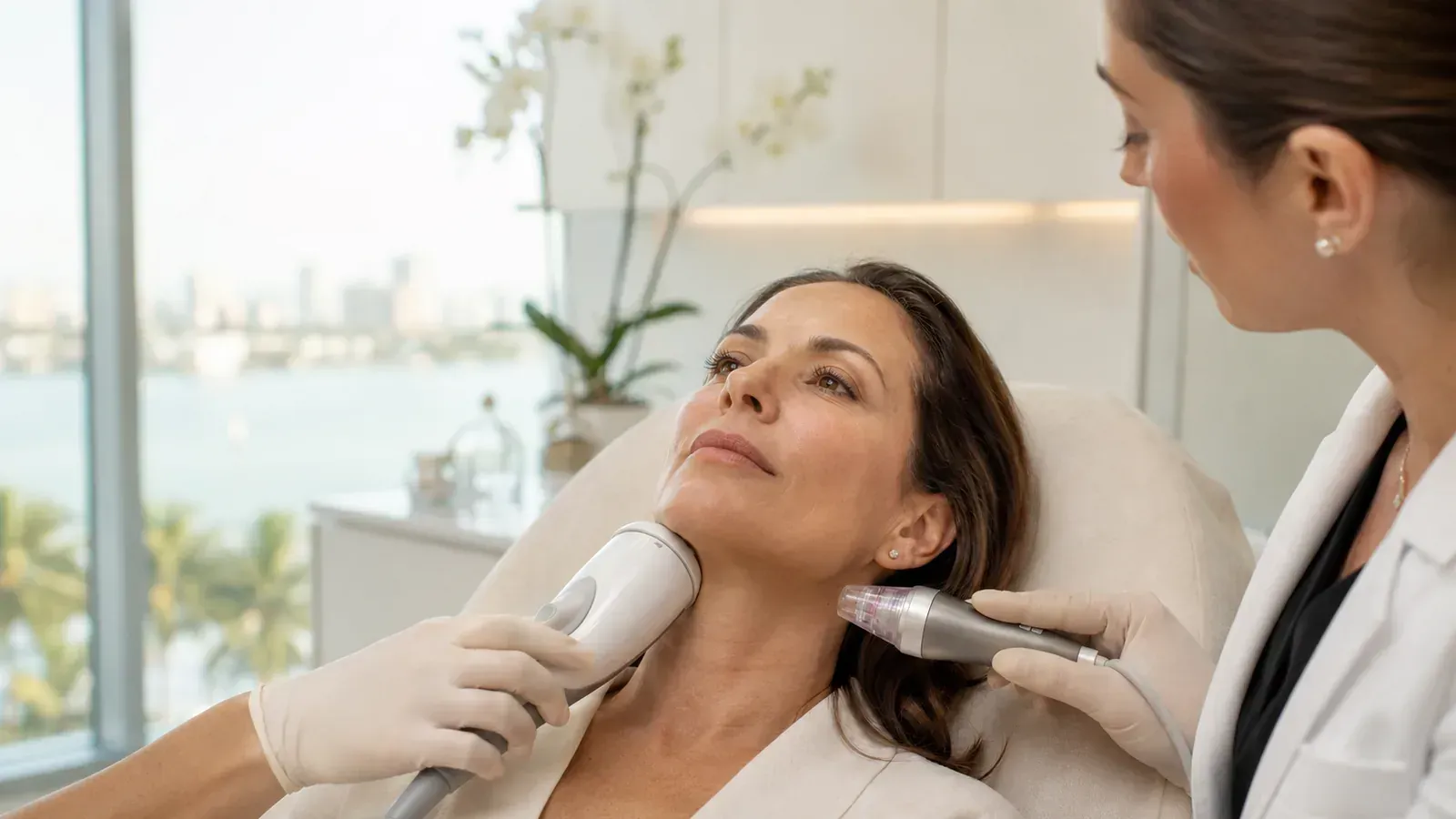
Accent Prime vs Morpheus8 in Miami: Two Different Approaches to Skin Tightening
Two people can walk into a Miami practice with the same complaint — “my skin feels looser than it used to” — and leave with two different treatment discussions. One might involve Accent Prime. The other, Morpheus8. That is not indecision. It reflects a simple reality: “skin tightening” is not a single procedure, and the two most-searched options work in fundamentally different ways.
If you have been comparing Accent Prime vs Morpheus8 for skin tightening, this guide explains what actually separates them: the general technology category, whether needles enter the skin, how invasive each is, and what recovery tends to involve. It is not a ranking, and neither device “wins.” The better question is which approach may be considered for your concern — and that depends on the treatment area, the technology as configured, and an individual assessment, not on a comparison chart alone.
The Core Difference: Energy Through the Surface vs Energy Delivered Beneath It
The most useful distinction is how the radiofrequency (RF) energy reaches the skin.
Accent Prime is an Alma aesthetic platform that may combine radiofrequency and ultrasound technologies, depending on the configured system and applicators. In a skin-tightening context, non-invasive RF energy is generally delivered through the intact surface of the skin to warm the deeper layers, with the aim of prompting a collagen response. The skin surface is not broken. This is the “non-invasive RF/ultrasound” category. Exactly which technologies and applicators are involved depends on the specific system configuration, the treatment area, and the individual plan.
Morpheus8 is a fractional radiofrequency microneedling system made by InMode. Instead of heating through the surface, it uses fine microneedles to deliver RF energy beneath the skin at adjustable depths — which is why it is described as RF microneedling rather than non-invasive RF.
On regulatory status, one factual point can be stated carefully. Per InMode's 2024 announcement of an FDA 510(k) clearance, the Morpheus8 applicators are cleared for the delivery of fractional radiofrequency in dermatologic procedures where coagulation/contraction of soft tissue or hemostasis is needed. That is the extent of the cleared language — it does not, by itself, establish guaranteed wrinkle improvement, fat loss, cellulite reduction, or a facelift-equivalent outcome. (For Accent Prime, the regulatory status depends on the specific configured system and applicators, so no device-specific clearance claim is made here.)
Invasiveness and Comfort
Because non-invasive RF and ultrasound treatments deliver energy through intact skin, they are generally considered non-invasive, and many people describe the sensation as warming.
Morpheus8 involves microneedle penetration, which places it in the minimally invasive category. Practices commonly use topical numbing beforehand, and the sensation and aftercare differ from a purely surface treatment because the microneedles create tiny channels in the skin. Neither approach should be described as painless, and comfort varies from person to person with the area treated, the settings used, and individual sensitivity — a good topic for a consultation rather than an assumption from an article.
Recovery Considerations
For many people, recovery is the practical deciding factor.
Non-invasive RF and ultrasound treatments are typically associated with little social downtime, since the surface has not been broken — though experiences vary. Microneedling-based treatments more commonly involve temporary redness, swelling, and sometimes pinpoint marks as the skin heals; that window is generally short but real. There is no universal downtime figure for either, and anyone quoting an exact number of “days of downtime” before assessing your skin is guessing.
What Influences Which Approach Is Considered
Both approaches are used on the face and body, but which one may be considered depends on the treatment area, the concern being evaluated, the configured technology, and the individual treatment plan. As a general matter, RF microneedling reaches beneath the surface and can be planned at different depths, while non-invasive RF/ultrasound works through the intact surface. Whether either is relevant to a particular concern — and which might be considered first — is a provider assessment, not something to assign from a comparison chart. Skin tone is one of several factors a qualified provider weighs when planning any energy-based treatment.
Suitable Concerns — and When Neither May Be Enough
Both are generally discussed as options for mild to moderate skin laxity and skin-quality concerns. They rely on a collagen response, they take time, they typically involve more than one session, and results build gradually rather than appearing overnight.
It is just as important to be clear about their limits. Neither approach is a substitute for surgery. If the skin is hanging rather than simply feeling loose, or if laxity is advanced, a non-surgical energy treatment may not deliver the change someone is hoping for — and a candid provider will say so rather than recommend a series that cannot meet the goal. Likewise, if the real issue is lost volume, dynamic wrinkles from muscle movement, or significant fat, those are different problems calling for different tools. No skin-tightening device should be described as a permanent fix, a guaranteed result, or a replacement for surgery.
Treatment Planning
Responsible treatment planning starts with an evaluation, not a protocol: what you want to change, your skin, your history with devices or injectables, and your timeline. From there, a provider can explain whether a non-invasive RF/ultrasound approach, an RF microneedling approach, a different treatment, or a combination is reasonable — and, importantly, whether an energy treatment is likely to meet the goal at all.
The Bottom Line
Accent Prime and Morpheus8 are less competitors than two different tools for related jobs. One represents the non-invasive RF and ultrasound approach: energy through intact skin, generally minimal recovery. The other represents the RF microneedling approach: energy delivered beneath the surface, with a short recovery window. Which one may be considered depends on the treatment area, the concern being evaluated, the configured technology, and the individual plan — which is exactly what a consultation is designed to sort out.
Accent Prime and Morpheus8: The Main Differences
Technology Category
- Accent Prime is an Alma aesthetic platform that may combine radiofrequency and ultrasound technologies, depending on the configured equipment and applicators.
- Morpheus8 is a fractional radiofrequency microneedling system.
How Energy Is Delivered
- Non-invasive RF and ultrasound technologies work through the intact skin surface.
- Morpheus8 uses fine microneedles to deliver RF beneath the surface.
Invasiveness
- Accent Prime belongs to a non-invasive treatment category, depending on the configured technology.
- Morpheus8 is minimally invasive because microneedles enter the skin.
Recovery Considerations
- Non-invasive RF or ultrasound treatments are generally associated with less visible recovery.
- RF microneedling may involve temporary redness, swelling, or pinpoint marks.
- Recovery varies, and no fixed timeline is promised.
What Influences Treatment Selection
- Treatment area
- Concern being evaluated
- Exact device configuration
- Desired level of invasiveness
- Recovery preferences
- Individual assessment
Frequently Asked Questions
Is Accent Prime or Morpheus8 better for skin tightening?
Neither is universally “better.” They use radiofrequency differently — one delivers it through the intact surface, the other beneath the surface via microneedles. Which one may be considered depends on the treatment area, the concern, the configured technology, and the individual plan. A consultation is the appropriate way to decide.
What is the difference between RF skin tightening and RF microneedling?
RF skin tightening heats deeper tissue through the surface of the skin without breaking it. RF microneedling uses tiny needles to deliver RF energy below the surface. The two differ in invasiveness and recovery; which is relevant depends on the individual assessment.
Which one has more downtime?
Microneedling-based treatments typically involve a short recovery window with temporary redness and swelling. Non-invasive RF and ultrasound treatments are often associated with little social downtime. Experiences vary, and there is no fixed number of days for either.
Do either of these replace a facelift?
No. Both are generally discussed for mild to moderate laxity and skin-quality concerns and are not a substitute for surgery. If laxity is advanced, a surgical consultation may be the more honest path.
Does skin tone affect these treatments?
Skin tone is one of several factors a qualified provider weighs when planning any energy-based treatment. Whether either treatment is appropriate for you depends on an in-person assessment.
How many sessions will I need?
There is no universal number. Both are typically planned as a series, and the plan depends on the concern, the starting point, and the area treated. A provider outlines a realistic plan after an assessment.
Schedule a Consultation
Weighing these two approaches?
The right next step is an in-person assessment, where the treatment area, your concern, and the technology as configured can all be considered together. Comprehensive Medical Aesthetics serves the Miami and North Miami area. Book a consultation to talk it through.